The Cost of War
Henry VThe Cost of War is more than the battlefield’s tally of dead: the play frames it from the outset as a debt of responsibility, borne by the people who suffer and charged against the rulers who set war in motion. Its early warnings make the legitimacy of the claim against France inseparable from the human consequences of pursuing it.
The Claim and Its Human Liability
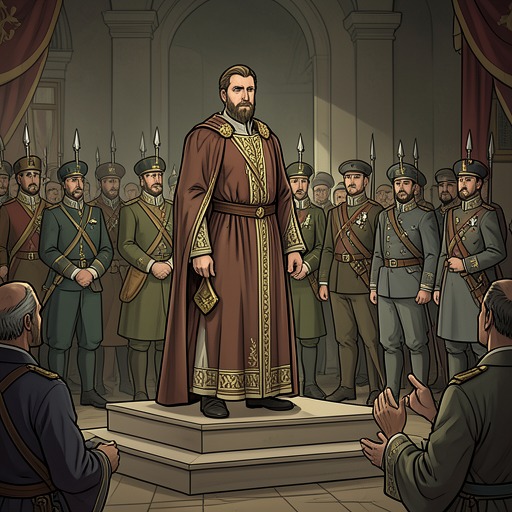
The debate over the Salic law begins as a question of whether that French rule should bar King Henry V’s claim. The Archbishop of Canterbury is asked to unfold the matter justly and religiously, but the discussion immediately reaches beyond legal interpretation: he warns the king to take care before committing himself or waking the sword of war. A conflict between two kingdoms, he insists, cannot come without great bloodshed. The innocent dead become an accusation against whoever’s wrong gives the swords their edge, placing responsibility for the coming violence alongside the argument over inheritance.
King Henry V answers the Dauphin’s mock with an image of transformation: the balls become gun-stones, and the insult is made to carry the consequences of war. His warning looks past military retaliation to its households and homes: widows will lose husbands, mothers their sons, and castles will be brought down. The threatened destruction is thus presented not as an abstract price of royal honor but as losses imposed on people far from the exchange of insults. In this first reckoning, the cost is already described in bereavement and ruin, before the campaign’s later scenes give those losses their bodies and numbers.
Civilian Suffering and the Threat at Harfleur
A demand that King Henry V surrender the crown invokes the people who will bear the cost if he refuses. The war is figured as a hungry force opening its jaws, while widows’ tears, orphans’ cries, the blood of the dead, and the grief of maidens are turned back toward the ruler responsible for continuing it. This appeal makes the consequences more than a forecast of battlefield casualties: it names the broken family ties and accumulated mourning that a royal decision sets in motion. Its religious language sharpens the charge, asking Henry to consider the souls exposed to war rather than treating the crown as the only stake.
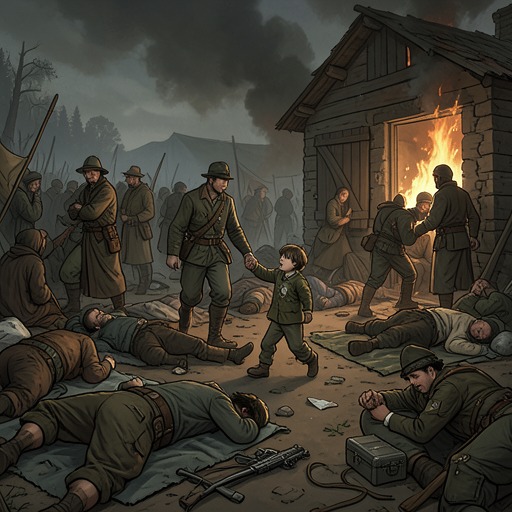
At Harfleur, the prospect of civilian suffering becomes an explicit instrument of military pressure. Henry declares that he will not leave the city half-conquered and threatens that its gates of mercy will be shut, leaving his soldiers free to range with bloody hands. He specifically invokes the danger of assault against the city’s daughters, then argues that the townspeople themselves will be responsible if they refuse to yield. The conditional threat exposes a contradiction at the heart of the play’s language of justice: Henry presents the violence as a consequence imposed on Harfleur for resisting, even as his own terms describe the English soldiers as its immediate agents. The threatened victims are not combatants, and the threatened acts include violation and destruction; their suffering is therefore part of the siege’s coercive logic, not merely an incidental consequence of battle.
Battlefield Judgment and the Count of the Dead
Before the battle’s aftermath, Michael Williams has already framed the casualties as a moral account that the king cannot simply assign to others. If the cause is unjust, he argues, King Henry V himself will face a heavy reckoning when the severed legs, arms, and heads of the dead seem to join in accusation. The image turns military loss into a test of the king’s claim: victory cannot, by itself, settle whether the cause was right or release its author from responsibility.
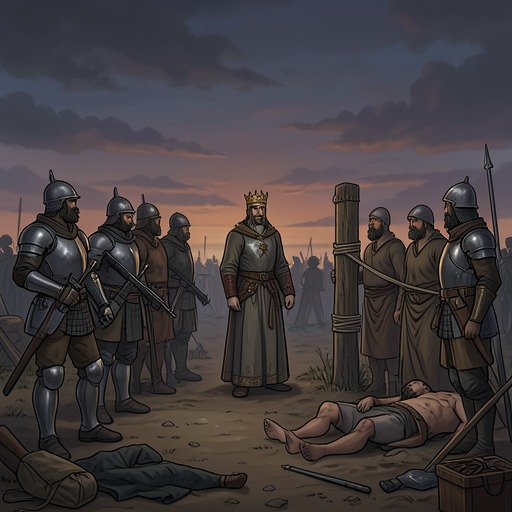
That burden sharpens when an alarm reports that the French have reinforced their scattered men. King Henry V orders every soldier to kill his prisoners. The order makes the cost of battle fall not only on those fighting in the field but on captives already in English hands, and it marks a stark change from the possibility of mercy to deliberate execution. Later, the killing is explained by the report that the French burned and carried away everything in the king’s tent; King Henry V is said to have caused every soldier to cut his prisoner’s throat. The explanation connects the executions to the assault on the camp, but does not erase the king’s responsibility for commanding them.
After the slaughter, Montjoy asks for charitable permission to search the bloody field, find the dead, bury them, and distinguish nobles from common soldiers. The request makes burial and identification part of the aftermath: the dead must be recovered and sorted even after battle has turned bodies into a collective toll. King Henry V receives a report that ten thousand French lie slain, including princes and nobles who bore banners. That number gives the play’s earlier warnings a terrible scale, while the appeal to bury the dead insists that the reckoning is made of individual bodies and ranks, not numbers alone.
Responsibility Beyond the Battlefield
The play measures war through more than its immediate military outcome. Its language moves from a warning that innocent blood will accuse the ruler who gives the swords their cause, to specific threats against households, then to an order that turns prisoners into victims after the fighting has begun. The sequence makes the human cost both anticipated and enacted: loss is not an unforeseen shadow of policy but a consequence repeatedly named before it is imposed. Royal authority is therefore tested not only by the claim it advances or the battle it wins, but by the people exposed to its decisions.
The dead also resist being reduced to a single political account. Williams imagines the severed limbs and heads returning as witnesses against an unjust cause; Montjoy asks to find and bury the fallen, separating nobles from common soldiers; and the report of ten thousand French dead gives the losses a staggering total. Together, accusation, burial, and counting expose different dimensions of responsibility: whether the war is just, what commands are given within it, and what duties remain toward those it has killed. The Cost of War is thus a moral reckoning that victory cannot close.